
'A deal will only be possible if India stops buying Russian oil -- but even then, New Delhi must not compromise its core red lines.'

Formula One has cancelled the Bahrain and Saudi Arabian Grands Prix scheduled for April due to escalating Middle East tensions, reducing the 2026 F1 calendar from 24 to 22 races.
'America is adopting the typical 'my way or the highway'/'Either you are with us or against us' stance.' 'This is a policy India is not going to accept.'

Analysts predict a surge in gold and silver prices as investors seek safe-haven assets due to escalating tensions in the Middle East. The impact on domestic prices will depend on the conflict's duration, with geopolitical factors and macroeconomic data also playing a role.

Benchmark indices Sensex and Nifty experienced a significant decline, falling over 1 per cent due to foreign fund outflows and global uncertainties.
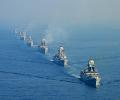
According to sources, the Indian Navy warships are on standby to provide assistance or help required by merchant vessels.

US President Donald Trump announced a new global levy on imported items, resulting in a lower tariff rate for India, following a Supreme Court verdict against his previous sweeping tariffs.

'Every day the meter is ticking. Like a time bomb.' Shipping giants are billing Indian exporters up to $3,000 per container in war surcharges -- on cargo that sailed before the war began -- as the Strait of Hormuz shuts down.

Yousef Pezeshkian, the son of the Iranian President, has confirmed that Iran's Supreme Leader Mojtaba Khamenei is 'safe and sound'. This comes after certain reports claimed that he had been injured during the ongoing strikes by the United States and Israel, according to Al Jazeera.
On President Putin's two-day trip to India, Jaishankar said for a "big" and "rising" country like India, it is important to maintain good cooperation with as many important players as possible in the world in line with freedom of choice.

New Delhi 'will have to take a call which supply source suits us the best,' the finance minister said, pointing out that crude oil accounts for the bulk of India's foreign exchange spend.
United States President Donald Trump on Wednesday said that the US is 'doing a trade deal with India' as the two sides continue to hold talks on the proposed trade pact.

'Trade deal will act as a strong trigger for market sentiment, not just for domestic investors but also for FIIs.'
'Trump is likely being purposefully vague, hoping that this lack of clarity will pressure India, fearing the worst, to agree to scale back its imports of Russian oil.'

The chairman of maritime company Safesea Group has described the attack on the US-owned crude oil tanker Safesea Vishnu, which resulted in the death of an Indian crew member, as "deliberate and calculated". He emphasised the need for governments to ensure the safety of commercial shipping lanes and seafarers.

United States Senator Lindsey Graham on Sunday claimed that Indian Ambassador to the US Vinay Mohan Kwatra spoke to him last month about India buying less Russian oil and asked him to tell President Donald Trump to relieve the 25 per cent tariff.

Alliances fight wars effectively only when they share an endgame. If Israel acted without US knowledge, then the military alliance is operating without real coordination at the level of strategic targeting. Neither picture is reassuring in a war that is no longer regional in its consequences. Prem Panicker continues his must read daily blog on the Gulf War.

A 500 per cent tariff would effectively shut out India's goods and services exports to the US.
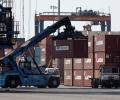
The commerce ministry on Friday held consultations with key stakeholders, including shipping lines, exporters, container firms, and other departments, to assess the impact of the Iran-Israel conflict on India's overseas trade, an official said. The meeting was chaired by Commerce Secretary Sunil Barthwal.

Fathali further stated that Tehran has instructed its embassy in India to facilitate the Indian government, ensuring smooth operations amid the ongoing regional conflict.

Stock markets rebounded on Friday with the benchmark Sensex closing higher by 316 points after heavy buying in banking and metal shares amid optimism over trade deal progresses and India's participation in Pax Silica.

Whether Trump will actually press ahead with the oil sanctions remains unclear, since keeping Russian oil out of the world market risks high oil prices which could boomerang on the US economy and be damaging politically for Trump, points out Ambassador M K Bhadrakumar.
Lutnick said that these countries have to understand that if "you want to sell to the US consumers, you've got to play ball with the President of the United States."
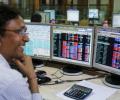
Benchmark equity indices Sensex and Nifty extended their gains for the second straight session on Monday, driven by optimism over the India-US trade deal and robust buying in public sector banks, consumer durables, and realty stocks.

Discovering the stunning land of breathtaking temples.

'The next two to three weeks will not be decided in Washington.' 'They will be decided in Tehran, in whatever calculation Iran makes about the costs of continued resistance against the costs of appearing to have yielded.'
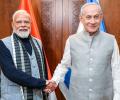
India and Israel share a deep historical bond, and Prime Minister Modi's visit to the Knesset marked a bold shift from past diplomatic hesitation to open strategic partnership.

'In my experience of politics, I have seen political grips and political chokes are mostly hidden. The average person cannot see them,' Rahul Gandhi said.

Among Sensex firms, Asian Paints jumped the most by 4.18 per cent. Mahindra & Mahindra, Bharti Airtel, ITC, Hindustan Unilever, ICICI Bank and Reliance Industries were also among the gainers. However, Infosys, HCL Tech, Eternal, Tech Mahindra and Tata Steel were among the laggards.

Benchmark indices Sensex and Nifty ended lower on Thursday, snapping a three-day rally, amid a weak trend in global stock markets.

Inflation data, trading activity of foreign investors and global trends would dictate sentiment in the stock market this week, according to analysts.
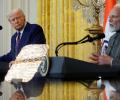
India and the US have entered a new phase in their relationship, marked by greater parity, point out Harsh V Pant and Vivek Mishra.

Modi also said that President Trump's leadership is vital for global peace, stability, and prosperity.
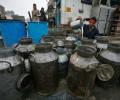
India has fully protected its sensitive sectors like dairy, rice, wheat, pulses, tea, genetically modified (GM) goods, and coffee by not granting any import duty concessions to the European Union (EU) under the bilateral free trade agreement, according to the Commerce Ministry.

Benchmark equity indices Sensex and Nifty tumbled more than 1 per cent on Friday due to across-the-board selloff, especially in metal, IT and commodity stocks, tracking sluggish global markets.

India's crude oil imports from Russia saw a marginal decline in September, but continued to account for over one-third of the country's total oil purchases, despite US pressure to curb the trade over concerns that it supports Moscow's war effort in Ukraine. India's crude imports in September were around 4.7 million barrels per day, up 220,000 bpd month-on-month and flat year-on-year.

A group in Varanasi organized an 'India-Russia Friendship March' to welcome Russian President Vladimir Putin ahead of his visit to India for the annual summit with Prime Minister Narendra Modi. The march highlighted the strong ties between the two nations and expressed hope for strengthened cooperation and global peace.

Domestic equities surged on Tuesday, posting their best single-day gains in more than eight months after a long-awaited trade deal between India and the US. The deal, which lowered tariffs on Indian goods to 18 per cent from 50 per cent, significantly improved investor sentiment and lifted a key overhang for the market.

Equity benchmark indices Sensex and Nifty advanced for the third straight session on Tuesday driven by firm global cues and optimism over India-US trade agreement, even as investors turned to profit-booking at higher levels.

Indian OMCs have not been buying Iranian or Venezuelan crude which is actually sanctioned by US. OMCs have always complied with the price cap of $60 for Russian oil recommended by the US.
